英文解読練習として英語のニュースから日本語に翻訳された記事をよく読んでいますか?このコーナーではそんな世界の面白いニュースとその日本語訳をピックアップしてご紹介します。リーディングや外国人に話しかける時にも、緊張をほぐして、会話のきっかけとしていかがですか?
英語:“Trailblazing artist Yayoi Kusama dies at 97”
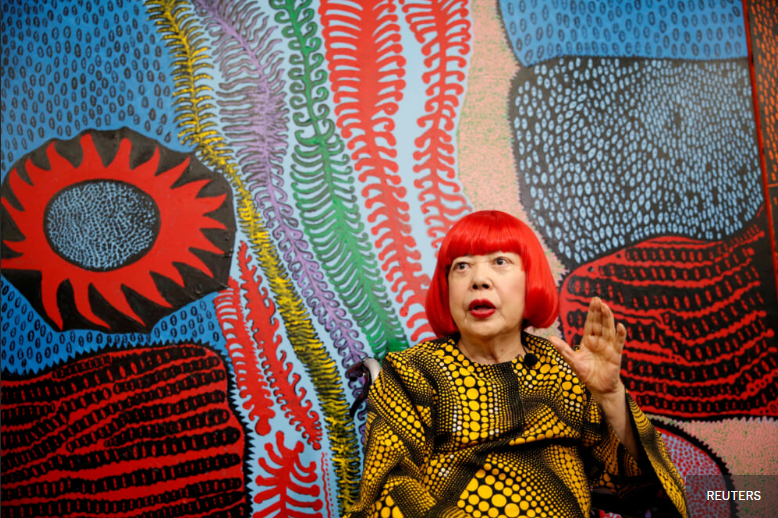
Yayoi Kusama, the acclaimed Japanese avant-garde artist who transformed her hallucinations into works that ranged from vibrant dot-covered paintings and pumpkin sculptures to infinity mirror room installations, has died at the age of 97.
Diminutive and known for sporting a scarlet bob wig later in life, Kusama was candid about her mental health struggles, saying she had experienced visions and hallucinations of flashing lights, dots and flowers since childhood.
“I still see hallucinations even now,” she told reporters in 2017. “Dots come flying everywhere — on my dress, the floor, things I’m carrying, throughout the house, the ceiling. And I paint them.”
Kusama died in a hospital on Aug. 14, according to a statement by the Yayoi Kusama Museum. No cause of death was given.
During her lifetime, she became a huge commercial success — a rarity for an artist, particularly a female one. Her international exhibitions attracted huge crowds and her works often sold for more than $1 million (¥160 million). One painting, Untitled (Nets) (1959), sold for $10.5 million (¥1.6 billion) in 2022.
Among her most well-known pieces are the Infinity Mirror Room series. One of those, Narcissus Garden, features between 1,000 and 1,500 mirrored spheres that mimic a shifting reflective field. She first presented it in 1966 at the Venice Biennale, attempting to sell the spheres to visitors for about $2 (¥320) each. A sign read: “Your Narcissism For Sale.”
Born on March 22, 1929, in Matsumoto City, Nagano Prefecture, Kusama had a troubled childhood marked by family conflict. She said she was overwhelmed by fear and that it reached the point where she wanted to die every day.
“What kept me from ending my life was drawing and making art. That has never changed. It was through discovering my love of art that I have been able to survive and continue living to this day,” she said in a 2014 interview with Vogue Japan.
日本語:“世界的に愛された芸術家、草間彌生さん死去”
高く評価された日本の革新的な芸術家で、色鮮やかな水玉模様の絵画やかぼちゃの彫刻をはじめ、無限の鏡の部屋に至るまでの作品に自身の幻覚を変容させた草間彌生さんが97歳で死去した。
小柄で、晩年には緋色のショートボブのウィッグをかぶっていることで知られていた草間さんは、自身の精神疾患の苦しみについて率直で、子どものころから点滅する光や水玉模様、花などの幻視や幻覚があったと語っていた。
「今でもまだ幻覚が見える」と彼女は2017年に報道関係者に語った。「水玉模様はあちこちから飛んでくる―服にも、床にも、私が持っているもの、家中、天井にも。そして、私はそれらを描いている」。
草間彌生美術館が発表した声明によると、草間さんは8月14日に病院で死去したという。死因は書かれていなかった。
彼女は生涯の間に、商業的な大成功を収めた―芸術家としては珍しく、特に女性の芸術家では稀だった。彼女の世界的な展示会には大勢の人々が集まり、彼女の作品はよく100万ドル(1億6,000万円)以上で売れた。絵画の1作品『Untitled (Nets)(無題〔網〕)』(1959年)は2022年に1,050万ドル(16億円)で売れた。
彼女の最も有名な作品の中には、『無限の鏡の部屋』シリーズがある。そのシリーズのうちの1作品『ナルシスの庭』には、変化する反射のフィールドを再現した1,000個から1,500個の鏡面の球体が登場する。彼女は最初にこの作品を1966年のヴェネチア・ビエンナーレで発表し、来場者にこの球体を1つ約2ドル(320円)で売ることを試みた。看板にはこう書かれていた:「あなたの自己愛、販売中」。
草間さんは1929年3月22日に長野県松本市で生まれ、家族の葛藤によって特徴づけられた波乱に満ちた子ども時代を過ごした。彼女は恐怖に押しつぶされそうだったと語り、恐怖は毎日死にたいと思うくらいにまで達したと述べた。
「自殺を思いとどまらせてくれたのは、絵を描いたり、作品をつくったりすることだった。それは私の生涯を通して、ずっと同じです。芸術への愛を見出して、私は今日まで生きてこられた」と彼女は2014年の『ヴォーグ・ジャパン』のインタビューで語った。
Copyright The Japan Times, Ltd.
原文を読む≫