英文解読練習として英語のニュースから日本語に翻訳された記事をよく読んでいますか?このコーナーではそんな世界の面白いニュースとその日本語訳をピックアップしてご紹介します。リーディングや外国人に話しかける時にも、緊張をほぐして、会話のきっかけとしていかがですか?
英語:“As Spain swelters, a centuries-old accessory is having its moment in the sunshine”
In crowded subway cars and sun-drenched plazas, an old-fashioned accessory in Spain has been everywhere thanks to the blistering summer heat.
Small enough to fit into a purse, the traditional Spanish folding hand fan, or abanico, snaps open into a semicircle. With little more than a flick of the wrist, it creates a surprisingly strong breeze.
As successive heat waves in Western Europe pushed temperatures this summer to punishing levels, the accessory has become essential, embraced by young and old from Spain and elsewhere. Women — and a growing number of men — unfurl them on public transport, at concerts and at music festivals. In July, rainbow-colored abanicos were everywhere during Madrid’s raucous Pride celebrations.
On a recent August day, 20-year-old Ana Feliu blocked the sun with a paper abanico she was gifted during a Valencian festival. She carries it everywhere in the summer, she said.
“This one is my favorite because it’s the biggest, but I have many more,” she told The Associated Press near Madrid’s Puerta del Sol square. Later in the week, temperatures in the Spanish capital were expected to reach 39 degrees Celsius.
Also fanning himself was David González, whose abanico featured pinks, purples and reds.
“At first, I felt a little self-conscious, because it’s something that’s mainly associated with women, but I have to admit it serves a purpose — and it brightens my day,” said González, 53.
Historians believe the folding fan reached Europe through Portuguese maritime trade with Asia in the 15th and 16th centuries.
As early as the mid-17th century, the Spanish painter Diego Velázquez made his enigmatic The Lady with a Fan, in which a woman, possibly French, poses with what appears to be a delicate wooden abanico.
As they grew fashionable in European courts, Spain developed a taste and industry of its own. Madrid became an important center of production, and by the 18th century, Valencia had emerged as the Spanish fan-making capital.
“During the 18th century, the printing industry really took off. And printing meant that the leaves of fans could be produced quite cheaply,” said Mary Kitson, curatorial consultant to The Fan Museum in London.
So embedded was the abanico in Spanish aristocratic society by the 1800s that women used them to discreetly express flirtation, interest or disapproval through what was called “the language of the fan.”
From Spain, the hand fan traveled to Latin America. In the 19th century, flamenco dancers began using the abanico as an expressive prop, as Cuban song and dance styles such as the guajira influenced the dance form. Over time, the fan’s association with flamenco helped turn it into a quintessential Spanish symbol.
“The fan is a perfect element because, on the one hand, it evokes the heat and humidity of Cuba — that heavy, oppressive feeling,” said Carmen Torres, a 44-year-old flamenco dancer in southern Spain. “And at the same time, it gives us a way to bring out the seductive, coquettish quality.”
For more than a century and a half, Javier Llerandi’s family has sold abanicos out of Casa de Diego, a wood-paneled shop in Madrid.
The fans at Casa de Diego are made in Spain and range from simple two-tone wooden ones to elaborate, hand-painted items crafted from mother-of-pearl with intricate floral patterns. They start at around €30 (¥5,400), while others range from €200 to €500 (up to ¥90,000), with some high-end pieces reaching €6,000 (about ¥1 million). The price depends on the materials used, but even more so on the craftsmanship involved, he said.
As Madrid has grown into a tourist hot spot, foreign visitors are also snatching up his fans, which Llerandi notes are more reliable than their portable, electric counterparts.
“Battery-run items eventually run out of power, and always at the worst possible moment,” Llerandi said, adding with a smile: “Without a doubt, heat waves are good for this business.”
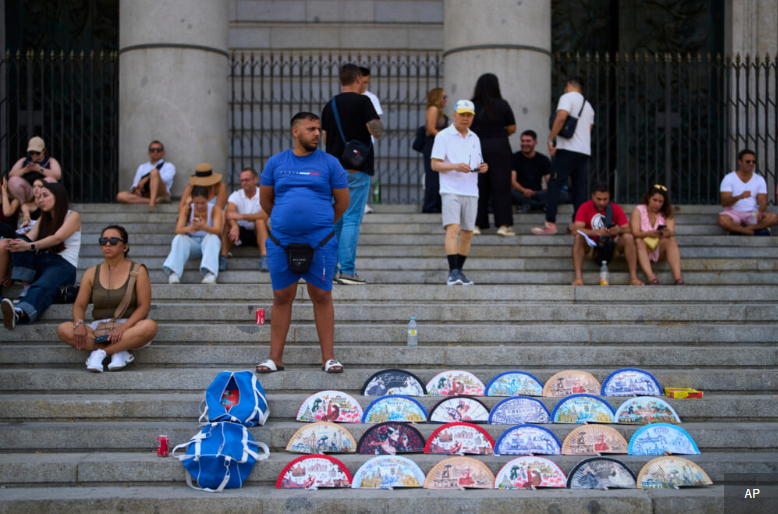
And for the less discerning customer, plastic fans with printed designs are sold for a few euros at souvenir kiosks, including one a couple hundred meters from Llerandi’s store. There, too, a salesperson reported strong sales this summer.
Outside a towering bullfighting ring in Madrid, Juani Duran sells wooden hand fans with traditional floral designs for €5 (¥900) apiece at a stall. Bullfights take place in open-air stadiums, and spectators traditionally dress up to attend them, making the elegant fans a fitting accessory.
“You’ll usually find a hand fan in any woman’s pocket — and in some men’s, too,” Duran said before a late-August bullfight.
“They’re not the best quality,” she said, pointing at her stock, “but they’ll get you through the summer.”
日本語:“スペイン文化に根付く扇子、猛暑で大人気”
混雑した地下鉄の車両や日差しの照り付ける広場では、猛烈な夏の暑さのおかげで、昔ながらのスペインの服飾品があちらこちらに見られるようになった。
ハンドバッグに収まるほど小さいこの伝統的なスペインの扇子「アバニコ」は、さっと開くと半円形になる。手首を軽く振るだけで、驚くほど強い風を起こす。
西ヨーロッパで相次ぐ熱波が今年の夏の気温を過酷なレベルに押し上げる中で、この服飾品は欠かせないものとなり、スペインやその他のあらゆる地域で若者にも高齢者にも受け入れられている。女性、そしてますます増えつつある男性が、公共交通機関やコンサート、音楽フェスティバルで扇子を広げる。7月には、マドリードでの騒々しい(LGBTQ+の権利を祝う)プライド・パレードで、虹色のアバニコが至る所で見られた。
最近の8月のある日、20歳のアナ・フェリウさんは、バレンシアの祭りでプレゼントされた紙製のアバニコで日差しを遮っていた。彼女はそれを夏にはどこへでも持っていっていると話した。
「これは一番大きいのでお気に入りですが、他にもたくさん持っています」と彼女はマドリードのプエルタ・デル・ソル広場近くでAP通信に語った。その週後半のスペインの首都の気温は摂氏39度に達すると予想されていた。
同じく自分を扇いでいるのは、ダヴィド・ゴンザレスさんで、彼のアバニコはピンク、紫、赤が施されている。
「扇子は主に女性と関連付けられるものなので、最初はちょっと人目が気になりましたが、扇子が役に立つことは認めざるを得ません。それに、扇子は私の一日を明るくしてくれます」とゴンザレスさん(53)は述べた。
扇子は、15世紀と16世紀、ポルトガルによるアジアとの海上貿易を通じて欧州に渡ったと歴史家は考えている。
早くも17世紀半ばには、スペインの画家ディエゴ・ベラスケス(スペインの宮廷画家)が謎めいた「The Lady with a Fan」(扇子を持つ婦人)を製作していた。この絵画の中で、フランス人と思われる女性が、繊細な木製のアバニコと見られるものを持ってポーズを取っている。
欧州の宮廷で扇子が流行するにつれ、スペインは独自の嗜好(しこう)と産業を発展させた。マドリードは重要な生産の中心地となり、18世紀までにはバレンシアはスペインの扇子製作の中心地として台頭するようになった。
「18世紀には、印刷産業が飛躍的に発展しました。印刷をするということは、扇子の扇面がかなり安く生産できるということでした」と、ロンドンにある扇博物館の学芸コンサルタントのマリー・キットソン氏は述べた。
1800年代までにアバニコはスペインの貴族社会にとても深く根付いていたため、女性は「扇子の言葉」と呼ばれるものを通じて、扇子を使ってさりげなく、好意を持つ相手に気軽に関心を示す行為や、興味、不満を表した。
スペインから、扇子はラテンアメリカへ渡った。19世紀には、グアヒラ(キューバの民族歌謡)といったキューバの歌と踊りの様式がフラメンコに影響を与えるにつれ、フラメンコダンサーが表現力豊かな小道具としてアバニコを使い始めた。やがて、扇子とフラメンコの結びつきが、扇子を典型的なスペインの象徴へと変貌させる一因となった。
「扇子は完璧な要素です。一方で、キューバの蒸し暑さ、あの重くて抑圧的な感じを想起させるからです」と、スペイン南部のフラメンコダンサー、カルメン・トーレスさん(44)は述べた。「同時に、扇子は私たちに、魅惑的でなまめかしい感じをもたらす手段を与えています」。
1世紀半以上にわたって、ハビエル・ジェランディさんの家族は、マドリードにある木製パネル張りの店「カーサ・デ・ディエゴ」でアバニコを販売してきた。
カーサ・デ・ディエゴの扇子はスペインで作られ、シンプルな2つの色調の木製扇子から、真珠層から作られ精巧な花柄が手描きされた凝ったものまで、幅広い。価格は約30ユーロ(5,400円)からで、他に200ユーロから500ユーロ(最高で9万円)の価格帯のものもあり、6,000ユーロ(約100万円)に達する高級品もある。価格は、使われている材質によるが、それ以上に職人の手仕事にも左右されると彼は述べた。
マドリードが人気観光地に成長する中で、外国人旅行客も彼の扇子を買い求めている。持ち運べる電化製品の同等のもの(ファン)よりも、扇子のほうが信頼できるとジェランディさんは指摘する。
「電池で動く製品はいずれ電池切れになります。いつも、起こりうる最悪な瞬間に」とジェランディさんは話し、笑顔で付け加えた。「間違いなく、熱波はこの仕事にとって好都合です」。
あまり目の肥えていない客向けには、模様が印刷されたプラスチック製の扇子が、ジェランディさんの店から数百メートルの店を含む土産物屋で、数ユーロで販売されている。そこでも、販売員はこの夏の売上の多さを伝えた。
マドリードにそびえ立つ闘牛場の外で、フアニ・ドゥランさんは伝統的な花柄デザインの木製扇子を屋台で1本5ユーロ(900円)で販売している。闘牛は屋外のスタジアムで行なわれ、観客は伝統的に正装して観戦するため、優美な扇子は似合いの服飾品になる。
「扇子は普通、女性のポケットにあります。そして、一部の男性のポケットにも」とドゥランさんは8月下旬の闘牛が始まる前に話した。
「これらは最高品質ではありません」と彼女は在庫品を指さして語った。「ですが、夏を乗り越えさせてくれるでしょう」。
Copyright The Japan Times, Ltd.
原文を読む≫