英文解読練習として英語のニュースから日本語に翻訳された記事をよく読んでいますか?このコーナーではそんな世界の面白いニュースとその日本語訳をピックアップしてご紹介します。リーディングや外国人に話しかける時にも、緊張をほぐして、会話のきっかけとしていかがですか?
英語:“He was raised in the West, but he found his true home in Japan”
Ever read the works of Yakumo Koizumi? If you grew up in Japan, there’s a good chance you’ve read one of his most famous short stories, The Story of Mimi-Nashi-Hôïchi (Hoichi the Earless) in junior high school. It’s a scary but riveting story, full of ambience and period detail.
It appears in his celebrated collection Kwaidan: Stories and Studies of Strange Things, which also includes famous tales such as Yuki-onna and Rokurokubi. The collection was published in 1904, and shortly afterward translated into Japanese. The author’s name on Kwaidan may have been Japanese, but his birth name was Patrick Lafcadio Hearn. Hearn, whose mother was Greek and his father of English and Irish descent, became a Japanese citizen by marrying Setsuko Koizumi in the city of Matsue, Shimane Prefecture.
Hearn arrived in Japan in 1890 at age 40 as a news correspondent. He was in Matsue for 15 months; during that time he became enamored with the country, fell in love and got married.
After teaching English in Kumamoto and Kobe, Hearn began teaching English literature at Tokyo Imperial University (now the University of Tokyo) and lecturing at Waseda University.
For Hearn, Japan was both a wellspring of inspiration and the home he never had. As he wrote in Out of the East: Reveries and Studies in New Japan (1895), “The Occidental mind appears to work in straight lines; the Oriental, in wonderful curves and circles.”
Life in the West often disappointed Hearn, but Japan never had that effect on him — at least not on his writing. He fathered four children with Setsuko and was content with his work, family and life in Tokyo. Sadly, he died of heart failure in 1904 at the age of 54.
Hearn was born in 1850 on the Greek island of Lefkada. He did not have a happy childhood and this may account for a lifelong interest in ghosts and fantasy creatures. As a child, he must have craved love and companionship, even from imaginary beings. In fact, his early years were lonely and chaotic. Hearn’s father, Charles Hearn, was a medical officer in the British Army who was stationed in Lefkada. His mother was a Greek woman named Rosa Cassimati. Hearn had an older brother who died in infancy, and soon after his birth, his parents’ marriage began to fall apart.
When Hearn was 2 years old, Charles arranged for his wife and son to live with his family in Dublin but the move proved disastrous. Rosa was homesick and miserable, and she abandoned her husband to return to Greece while he was stationed in Crimea.
By the time Hearn was 7, his father had ended the marriage and his mother was married to another man in Greece. A little while later, Charles remarried as well and departed for India, appointing his aunt as Hearn’s legal guardian. Hearn never saw either of his parents again.
Perhaps the experience gave Hearn the deep sense that nothing is permanent and loneliness was inevitable. It’s not surprising that he became a voracious and passionate reader. He loved reading Greek literature and was particularly drawn to myths. When he was 11, he was sent to a school in France and became fluent in French, a skill that later enabled him to work as a literary translator.
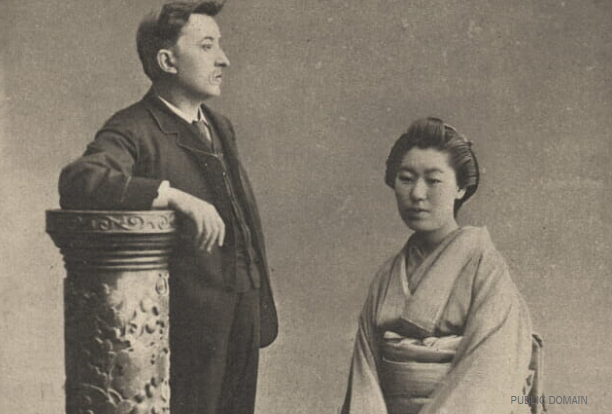
Hearn’s teen years were dark. At 16, he suffered an injury that blinded his left eye. The iris became permanently discolored, which made Hearn self-conscious and painfully shy. For the rest of his life, Hearn covered his left eye while conversing with people and always posed for the camera in profile.
At 19, Hearn was sent to Cincinnati, a city in western Ohio in the United States, to try and earn a living. For a while he was very poor, sleeping in stables in exchange for labor. But his fate changed in 1872, when he landed a job as a newspaper journalist and displayed a flair for the sensational and macabre. Two years later he married Alethea, an African American woman. At the time, interracial marriage was illegal in Ohio.
Hearn had a tendency to side with the impoverished and the downtrodden. Even after his marriage to Alethea failed, he wrote investigative articles about the living conditions in Black neighborhoods. He was captivated by Black music and culture in the post-Civil War period and turned his appreciation into newspaper articles.
In the West, Hearn was always battling something. But after coming to Japan, he stopped using his pen as a weapon and embraced the gentle strangeness of a world he had never seen, and experienced a love he had never known. As he wrote in Glimpses of Unfamiliar Japan (1894), “Japanese affection is not uttered in words; it scarcely appears even in the tone of voice: it is chiefly shown in acts of exquisite courtesy and kindness.”
日本語:“日本に「居場所」を見つけた作家、小泉八雲の生涯”
小泉八雲の作品を読んだことがあるだろうか? 日本で育ったならきっと、彼の最も有名な短い物語『耳なし芳一』を中学校で読んだだろう。恐いがとても魅力的な物語で、雰囲気と時代背景の細部描写があふれている。
この物語が出てくるのは、彼の有名な作品集Kwaidan: Stories and Studies of Strange Things(『怪談』)で、『雪女』や『ろくろ首』といった有名な物語も入っている。この作品集は1904年に(アメリカで)出版され、すぐ後に日本語に翻訳された。『怪談』の著者名は日本語だったかもしれないが、出生名はパトリック・ラフカディオ・ハーン。ハーンは母がギリシャ人で、父がイギリスとアイルランドの血筋で、島根県松江市で小泉節子(セツ)と結婚、日本国民になった。
ハーンは40歳だった1890年、特派員として日本に来た。松江市に滞在していた15ヵ月間で日本に夢中になり、恋に落ち、結婚した。
熊本市と神戸市で英語を教えた後、ハーンは東京帝国大学(現在の東京大学)で英文学を教え始め、早稲田大学で講義を始めた。
ハーンにとって日本はインスピレーションの源泉であり、今まで持ったことのなかった故郷でもあった。彼が『東の国から: 新しい日本における幻想と研究』(1895)で書いているように、「西洋の思考は縦の線で動くように見える;東洋の思考は素晴らしい曲線と円で動く」。
西洋での暮らしはハーンを落胆させることが多かったが、日本は彼にそうした影響を与えたことはなかった ― 少なくとも、彼の著作に対しては。彼は節子との間の4人の子の父親になり、東京で自分の仕事と家族と生活に満足していた。悲しいことに、彼は54歳だった1904年、心不全で死去した。
ハーンは1850年にギリシャのレフカダ島で生まれた。幸せな子ども時代ではなかったが、このことが生涯続く幽霊と幻想上の生物への興味の主な要因になったのかもしれない。子どもだった彼は、愛とつながりを求めていたに違いない。たとえそれが想像上の存在だったとしても。実際、幼少期は孤独で混乱したものだった。ハーンの父チャールズ・ハーンは、レフカダ島駐在のイギリス軍の医務官だった。母親はローザ・カシマティという名のギリシャ人女性だった。ハーンには兄が一人いたが乳児期に亡くなり、ハーンが誕生した直後に、彼の両親の結婚は破綻し始めた。
ハーンが2歳のとき、チャールズは妻と息子がダブリンの彼の家族と暮らせるように手はずを整えたが、その引っ越しは悲惨な結果となった。ローザはホームシックで憂鬱な気持ちになり、夫がクリミアに駐在している間に夫を置いてギリシャに戻った。
ハーンが7歳になるまでに、彼の父は結婚に終止符を打ち、母はギリシャで別の男性と結婚した。その少し後にチャールズも再婚してインドに出発、彼のおばをハーンの法的後見人に指定した。ハーンはどちらの親とも再び会うことはなかった。
この経験がおそらくハーンに、不変のものはなく、孤独は避けられないという強い思いをもたらしたのだろう。熱心で情熱的な読書家になったのも不思議ではない。彼はギリシャ文学を読むのが大好きで、特に神話に引き付けられた。11歳のときにフランスの学校に通って、フランス語に堪能になった。その能力のおかげでのちに、文学翻訳者として働けるようになった。
ハーンの10代は暗かった。16歳のときに、左目の視力を失うけがをした。虹彩が永久的に変色し、それが原因でハーンは人目を気にするようになり、ひどく内気になった。その後の人生で、ハーンは人と会話をする間、左目を覆い、カメラに向かうときはいつも横顔でポーズを取った。
19歳で、ハーンはアメリカのオハイオ州西部の都市シンシナティに派遣され、生計を立てようとしていた。しばらくの間とても貧しく、労働と引き換えに馬小屋で寝ていた。しかし彼の運命は1872年に変わった。新聞記者の仕事に就き、センセーショナルでぞっとするような話題で才能を発揮した。2年後、アフリカ系アメリカ人の女性アレサと結婚した。オハイオ州では当時、異人種間結婚は違法だった。
ハーンは貧しい人や抑圧された人の側につく傾向があった。アレサとの結婚がうまくいかなくなった後でさえも、黒人の生活状況に関する調査的記事を書いた。南北戦争後の時代に黒人の音楽と文化に魅了され、その理解を新聞記事にした。
西洋では、ハーンは常に何かと闘っていた。しかし来日後はペンを武器として使うのを止め、見たことのなかった世界の穏やかな奇妙さを受け入れ、知ることのなかった愛を経験した。『知られぬ日本の面影』(1894)で彼が書いたように、「日本の愛情は言葉の中では発せられない;それは声の調子にさえもほとんど表れない:それは繊細な礼儀と親切の行為で主に示される」。
Copyright The Japan Times, Ltd.
原文を読む≫